Janice Burgess Made a Career of Taking Children’s Imaginations Seriously
An art history graduate who got her start at Pittsburgh’s public television station, Burgess championed writers at Nickelodeon and helped shape shows from Gullah Gullah Island to Blue’s Clues. In The Backyardigans, she brought her own childhood imagination to the screen.

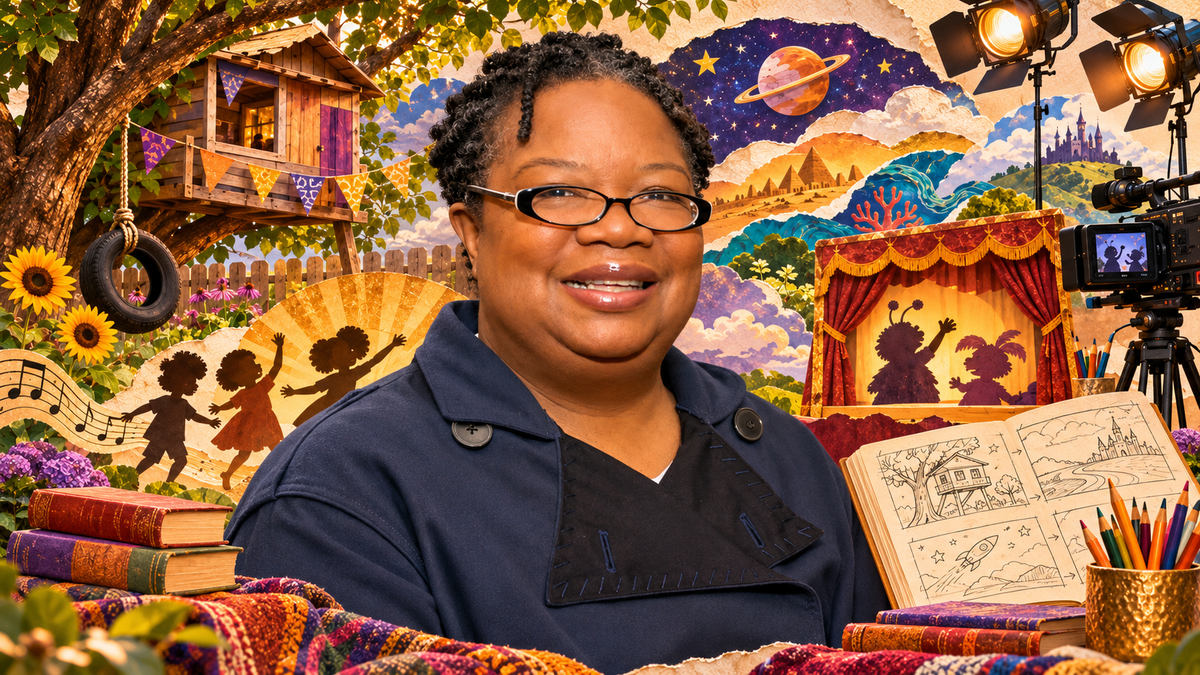
For a generation of children, five animated friends turned an ordinary backyard into an extraordinary world.
Uniqua. Tyrone. Pablo. Tasha. Austin.
They explored imaginary jungles, sailed distant oceans, became superheroes, solved mysteries, and traveled to places that existed only in their imaginations.
They sang. They danced. They made childhood feel like an adventure.
And for many of the families watching, there was something wonderfully familiar about them.
The names. The voices. The music. The personalities.
What millions of viewers may not have known was that the world of The Backyardigans came from the imagination of a Black woman named Janice Burgess.
But Burgess did far more than create one unforgettable television show.
She spent decades helping shape the programs that entertained, educated, and inspired generations of children. Before she introduced the world to Uniqua and her friends, Burgess had already played important roles behind some of the most recognizable programs in children’s television.
Her fingerprints were on childhood long before most of us knew her name.
Before Nickelodeon, There Was Pittsburgh
Janice Burgess was born on March 1, 1952, in Pittsburgh, Pennsylvania.
She grew up in the city’s Squirrel Hill neighborhood, where her childhood experiences would eventually become the foundation for her most famous creation.
As a young girl, Burgess loved stories, adventure, music, and the freedom of imaginative play. The backyard was a place where ordinary surroundings could become whatever a child’s imagination wanted.
But television wasn’t originally her career plan.
She attended the Ellis School and later studied art history at Brandeis University, graduating in 1974.
She initially imagined a future working in the art world.
Instead, she found herself drawn toward television production.
Her first significant step came at WQED, Pittsburgh’s public television station, where she took on practical, behind-the-scenes work, including craft services.

It wasn’t glamorous.
She learned about production schedules, coordinating people, and making sure the daily work of television actually happened.
Those early experiences gave her something invaluable: an understanding of how television was made, not just how it looked when the cameras started rolling.
Eventually, the aspiring art historian discovered that her real creative home was children’s television.
Learning the Business at Sesame Workshop
Burgess eventually moved to New York, where she worked at the Children’s Television Workshop, the organization now known as Sesame Workshop.
Her work included involvement with 3-2-1 Contact, the educational science series, and Ghostwriter, the mystery program designed to encourage literacy among young viewers.
On Ghostwriter, she served as a project manager, helping coordinate educational materials and related publishing work.
These weren’t starring roles. They were the behind-the-scenes positions that helped educational programming reach children effectively.
And they became part of her education in storytelling.
Burgess was learning how television could do more than occupy a child’s attention.
It could build curiosity.
It could introduce new ideas.
It could make learning feel like entertainment.
Those lessons would follow her into the next—and most influential—chapter of her career.
The Woman Behind Some of Nick Jr.’s Biggest Shows
In 1995, Burgess joined Nickelodeon’s preschool division, Nick Jr.
She became an executive responsible for overseeing television productions at a time when the network was expanding its identity as a destination for young children.
Over the years, her work included programs such as Gullah Gullah Island, Allegra’s Window, Blue’s Clues, and Little Bill.
Each represented a different approach to reaching young audiences.
Gullah Gullah Island brought an African American family and the cultural traditions of the Gullah people into homes across the country.

Blue’s Clues transformed problem-solving into an interactive experience.

Little Bill centered the everyday experiences of a young Black boy and his family.
Burgess did not create all these programs, but her production and executive work helped support their development and success.
That distinction matters.
Television history often celebrates the person whose name appears beside the words created by.
But the television business also depends on the executives, producers, story editors, and creative mentors who recognize ideas, protect creative visions, and help bring programs to life.
Burgess understood those roles because she had worked her way through them.
And the people who worked with her remembered much more than her job titles.
Writer and producer Fracaswell Hyman, who worked with Burgess on Gullah Gullah Island, later recalled how she recognized his talent and advocated for his involvement in additional productions.
She wasn’t simply supervising creative people.
She was helping other creative people find opportunities.
For a Black woman working in television during the 1990s, that influence carried significance beyond any single program.
A Rejected Idea Becomes a Television Classic
By the late 1990s, Burgess was ready to develop something of her own.
Her first concept was called Me and My Friends.
The proposed series featured characters performed through live-action, full-body puppet costumes.
The pilot was produced in 1998.
But Nickelodeon didn’t move forward with it as a series.
For some creators, that rejection might have meant the end of the idea.
For Burgess, it became a turning point.
Nick Jr. executive Brown Johnson saw potential in the characters and music and encouraged her to reconsider the concept as a computer-animated series.
Burgess returned to the drawing board.
The characters evolved. The visual approach changed. The storytelling possibilities expanded.
The result was The Backyardigans, which premiered on Nickelodeon in October 2004.

Across four seasons and 80 episodes, the show introduced children to five friends whose shared backyard became a doorway to endless adventures.
The premise was simple enough for preschoolers to understand.
Its execution was anything but simple.
The Music Was Never an Afterthought
One of Burgess’s most distinctive creative decisions was making music essential to the stories rather than treating it as background entertainment.
Each episode explored a particular musical style.

Jazz. Bossa nova. Reggae. Classical music. And dozens of other genres.
Children were hearing musical influences they might never have encountered through ordinary preschool programming.
That ambition required a talented creative team.
Composers Evan Lurie and Doug Wieselman helped develop the show’s expansive musical sound.
Writers, including lyricist McPaul Smith, created songs that advanced the stories while remaining accessible to children.
Choreographer Beth Bogush, whose background included the Ailey School, helped develop the movement that animators translated into the characters’ performances.
Watch the rehearsal for The Backyardigans Live! This 2008 feature follows Beth Bogush’s choreography for the stage production. Video by Julian Rad.
Burgess explained in a 2006 National Press Club presentation that a character’s performance combined the work of dancers, child voice actors, and animators.
The result was a children’s series with the scope and energy of a miniature stage musical.
A backyard could become a western frontier, a pirate ship, or an imaginary planet.
And the soundtrack would change with the adventure.
That creative ambition was unmistakably Burgess.
Uniqua Was Janice
Perhaps the most personal part of The Backyardigans wasn’t the music or the animation.
It was a small, pink, spotted character named Uniqua.
Unlike the other characters, whose appearances suggested recognizable animals, Uniqua was deliberately her own kind of creature.
She was curious, adventurous, confident, and often the one who set the group’s latest journey in motion.

And she was deeply personal to her creator.
In a 2009 interview with Investor’s Business Daily, Burgess explained:
“Uniqua is me. Or at least who I was as a kid. She’s a ringleader.”
That revelation changes the way we can understand the character.
Uniqua wasn’t simply an imaginative cartoon creation.
She reflected how a Black woman remembered herself as a little girl.
A girl who could lead.
Who could invent worlds.
Who did not need permission to be adventurous.
Uniqua was not waiting for someone else to create the story.
She was already imagining what happened next.
And somewhere, another child was watching her do exactly that.
Representation You Could Hear
There is another dimension to Burgess’s legacy that deserves attention.
For Black families, the cultural familiarity of The Backyardigans could be felt even without explicitly racialized human characters.
Tyrone and Uniqua, in particular, have inspired interpretations of Black cultural identity among viewers who recognized something familiar in their personalities, names, voices, and musical world.
That interpretation doesn’t mean the characters were officially assigned human racial identities.
It means representation can operate in ways that aren’t always visible.
Sometimes it is expressed through sound, rhythm, language, casting, and creative perspective.
Burgess and her colleagues gave considerable attention to those choices.
Brown Johnson, who helped lead Nick Jr., later spoke about Burgess’s commitment to casting children of color and giving young performers natural-sounding voices.
Johnson also emphasized that children needed opportunities not merely to see themselves on television but to hear themselves.
This is an important distinction.
Representation isn’t limited to a character who physically resembles the person watching.
It can also be a child recognizing a familiar voice.
A musical influence.
A sense of humor.
A cultural rhythm.
Or simply the feeling that the people who created a television world understood something about their own.
Burgess helped make room for that familiarity.
Her Career Didn’t End in the Backyard
Although The Backyardigans became her defining creation, Burgess continued contributing to children’s television after its original production period.
She worked on Nickelodeon’s version of Winx Club, taking on writing, story-editing, and creative responsibilities.
The series followed young fairies through a world of fantasy, friendship, and adventure—material that aligned naturally with Burgess’s affection for imaginative storytelling.
She also contributed to Bubble Guppies, another Nickelodeon preschool musical series, through production and creative work.
The connections between these shows were not accidental. Writers, producers, and other creative collaborators from The Backyardigans continued working together across children’s television.
Burgess’s influence was part of that creative network.
From 2014 to 2016, she also worked as an executive consultant for DreamWorks Animation Television, extending her experience beyond her longtime Nickelodeon home.
Her career wasn’t confined to one character, one format, or one generation of viewers.
She spent decades finding ways to make storytelling meaningful for children.
An Emmy, and a Legacy Beyond Awards
Burgess’s work received significant industry recognition.
The Backyardigans earned multiple Daytime Emmy nominations, and Burgess won a Daytime Emmy in 2008 for Outstanding Special Class Animated Program.

The series also inspired merchandise, recordings, and live theatrical productions.
But the scale of its cultural impact became especially clear years after its original premiere.
In 2021, songs from the show found new audiences through TikTok.
Castaways and Into the Thick of It! became viral favorites, introducing the music to listeners who had either grown up with the series or were discovering it for the first time.
The revival was more than nostalgia.
It showed that the musical world Burgess helped build could exist beyond the television episodes themselves.
The songs were still entertaining people.
The characters were still recognizable.
And the work was still reaching new generations.
Remembering the Woman, Not Just the Work
Janice Burgess died on March 2, 2024, in Manhattan after battling breast cancer. She was 72.
Tributes from former colleagues celebrated her creativity, intelligence, generosity, and devotion to children’s storytelling.
Nickelodeon recognized her as one of the influential architects of Nick Jr.
But her story also raises a larger question.
How many other Black women helped build the television programs, movies, music, and cultural experiences that shaped our childhoods—without receiving the public recognition their work deserved?
We remember the characters.
We remember the songs.
We remember what it felt like to sit in front of the television and disappear into an imaginary world.
But how often do we remember the people who made those worlds possible?
Janice Burgess was a television executive, a writer, a producer, a creator, and a mentor.
She helped bring important programs to the screen long before she created one of her own.
And when she finally did, she placed a little of herself in the center of the adventure.
A curious little girl from Pittsburgh who believed the world could become whatever she imagined.
That girl grew up to create a world that millions of children would enter.
We knew Uniqua.
Now it’s time we remember Janice Burgess.
⸻
Impeccably Black preserves and celebrates the people, creativity, and contributions that shape our shared history. Their voice. Their life, kept in full.